Our Stories
  • Home
  • Stan
  • Meg
  • Sarah
  • Phoebe
  • Latest News
    • Phoebe in Greece

Mum and Dad in Kyoto - Day 4

11/20/2014

0 Comments

 
The Ryokan we stayed at on Wednesday night looked out over Higashi Hongan-ji which is considered one of the largest wooden buildings in the world.  Established as a temple in 1321, Higashi Hongan-ji is also the name for the Buddhist Sect which is based there.  It means 'The Eastern Temple of the Original Vow' and is one of the dominant sub-sects of Shin Buddhism in Japan and abroad.
Picture
Picture
After visiting the temple, we jumped on a train and went to Arashiyama, about 20 minutes out of Kyoto Station.  
Picture
Picture
We hiked up a hill to the Iwatayama Monkey Park where there are about 170 Japanese macaque, or snow monkeys and a great view out over Kyoto.

We then visited Tenryū-ji — the head temple of the Tenryū branch of Rinzai Zen Buddhism, founded in 1339.

After seeing the temple we passed through the garden and entered Arashiyama's Sagano bamboo forest. 
Picture
Picture
0 Comments

Mum and Dad in Kyoto - Day 3

11/19/2014

1 Comment

 
This morning we started with a wonderful breakfast at our Ryokan.  
Picture
A Ryokan is a traditional Japanese inn that originated in the Edo period (1603–1868), when they served travellers along Japan's highways.  They typically have tatami-matted rooms, communal baths, and other public areas where visitors wear yukata and talk with the owner.
We are staying at three different Ryokan in Kyoto.  Last night was our first night.  We didn't have a communal bath, but a private one with a wooden tub.  In the morning, the lady in this picture came in to put our beds away and make us breakfast.  
We had to choose between Western or Japanese breakfast.  Easy choice. It was a massive breakfast with lots of food we hadn't tried before - all of which was delicious.

After finishing breakfast, we headed off back up the hill to see some more temples, including the famous Kiyomizu-dera Temple.
Picture
Picture
However, we had to start the day with some incense burning and a wander around the 24 metre Boddhisattva Avalokitesvara at Ryozen Kannon.  This is a temple built by Hirosuke Ishikawa in 1955 to honour fallen Japanese as well as foreign national soldiers who died in World War II.
Then we met some geisha along the way.  Actually, they looked too young to be geisha and they were probably apprentices called maiko ("dance child") or hangyoku  ("half-jewel"), meaning that they are paid half of the wage of a full geisha.
Picture
The Kiyomizu-dera Temple was founded in the early Heian period, around 798.  Its present buildings were constructed in 1633.  There is not a single nail used in the entire structure.  
Picture
It takes its name from the waterfall within the complex, which runs off the nearby hills.  Kiyomizu means clear water, or pure water.
Picture
Picture
Picture
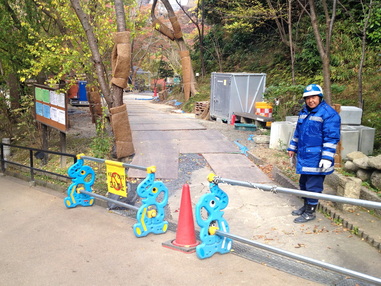
After leaving, we saw some road work fencing we thought you'd like Meggy.  We also saw another lucky dog going for a 'stand'.  I don't think Ella could stay still this long.
Picture
Picture
Later that afternoon, we went to visit Ginkaku-ji, which means "silver pavilion".
Picture
Ginkaku-ji was originally built to serve as a place of rest and solitude for Shogun Ashikaga Yoshimasa who had inspired a new outpouring of traditional culture.  Having retired to the villa, it is said Yoshimasa sat in the pavilion, contemplating the calm and beauty of the gardens as the Ōnin War worsened and Kyoto was burned to the ground.
Picture
In addition to the temple's famous building, the property features wooded grounds covered with a variety of mosses. The Japanese garden was designed by the great landscape artist Sōami.  The sand garden of Ginkaku-ji has become particularly well known - the carefully formed pile of sand which is said to symbolise Mount Fuji is an essential element in the garden.
Picture
1 Comment

Mum and Dad in Kyoto - Day 2

11/18/2014

0 Comments

 
Picture
Picture
Picture
Picture
Picture
Picture
0 Comments

Mum and Dad in Kyoto - Day 1

11/17/2014

2 Comments


Kinkaku-Ji and Ryoan-Ji Temples

Picture
On our first day in Kyoto we visited Kinkaku-ji - the Golden Pavilion.  It floats like an apparition over the surrounding pond.  
Picture
Picture
Originally built in 1397 as a retirement villa for shogun Ashikaga Yoshi-mitsu.  It was burnt down in 1950 by an obsessed monk and reconstructed shortly after.  
It is covered in gold leaf and features a phoenix on the top of the roof.  It is considered the second most famous sight in Japan after Mt Fuji. Even dogs come to see it !


Picture
Picture
We then visited Ryoan-ji, most famous for its rock garden.  The garden was arranged some time between 1333 - 1576.   It is called a hira-niwa, a flat garden void of hills or ponds.  It is said to reveal the simplicity and harmony of Zen meditation.
Picture
Later on we visited the Kyoto Imperial Palace.  Then we went out for dinner. 
Picture
Picture
Picture
2 Comments

    Archives

    November 2014
    August 2014
    July 2014
    June 2014
    March 2014
    November 2013
    October 2013

    Author

    Now we are back home in NZ, here are some more stories from Stan, Meggy, Sarah and Phoebe

    Categories

    All

    RSS Feed

Powered by Create your own unique website with customizable templates.